
AI-Native Industrial Robotics: How Standard Bots Is Reshaping Automation Economics and Deployment Models
, 3 min reading time
, 3 min reading time
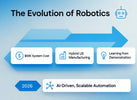
At Automate 2026, Standard Bots highlighted a major shift in industrial automation driven by AI-native robotics, lower system costs, and simplified deployment. With ~$50K systems, hybrid US-based manufacturing, and learning-from-demonstration capabilities, the company signals a transition from complex, engineer-heavy integration toward scalable, software-defined automation. This evolution is expanding robotics adoption beyond large enterprises into mid-market manufacturing, where demand is now outpacing supply.
At Automate 2026, one message stood out clearly: robotics is no longer an exclusive, capital-intensive investment reserved for large-scale enterprises. Standard Bots is actively reshaping the cost structure of industrial automation, with deployed systems reportedly around the $50K range.
From an engineering standpoint, this pricing shift is more than incremental—it fundamentally changes ROI modeling. Automation projects are no longer limited to high-volume production lines; they are becoming viable for flexible manufacturing cells, low-to-mid batch production, and even pilot lines.
My view is that this price compression will force integrators to rethink value delivery. Hardware is becoming less of a differentiator, while software adaptability and lifecycle support will define competitiveness.
One of the most significant transitions highlighted by Standard Bots is the move from traditional robot programming to AI-assisted task learning. Instead of relying heavily on robotics engineers writing structured code, systems can now learn from demonstration.
This is not just a UX improvement—it represents a shift in control architecture. The robot is no longer a rigid executor of predefined paths but a semi-adaptive system capable of interpreting operator intent.
However, from an engineering perspective, this raises a critical question: how deterministic are these learned behaviors in safety-critical or high-precision environments? The industry will need to balance flexibility with verifiability, especially in regulated production lines.
Standard Bots adopts a hybrid manufacturing strategy—designing core components in-house while selectively outsourcing elements such as motors and metal fabrication. PCB production in New York signals a strong push toward domestic capability building.
This model is pragmatic. Full vertical integration is often economically inefficient at early scale stages. Instead, hybridization allows faster iteration while maintaining supply chain flexibility.
In my experience, this approach often becomes a transitional phase. As volumes increase, companies typically internalize higher-margin or bottleneck components first, gradually tightening control over critical subsystems.
Traditional leaders such as Universal Robots, ABB, and FANUC remain benchmarks in reliability and installed base. However, the competitive axis is shifting.
Standard Bots is not attempting to outperform incumbents on raw industrial robustness alone. Instead, it is redefining the buying criteria: ease of deployment, AI-assisted configuration, and lower upfront investment.
This is important. Incumbents are optimized for large-scale, highly standardized environments. The emerging wave targets “long-tail automation”—diverse, smaller applications that were previously uneconomical to automate.
My perspective: the real disruption is not displacement but expansion. The market is growing outward, not just reshuffling.
A key insight from the Automate 2026 discussion is that demand is now exceeding supply in some segments. This is unusual in industrial automation, where adoption has historically been supply-pushed and consultant-driven.
Today, manufacturers are actively seeking automation solutions due to labor constraints, reshoring pressures, and rising production variability. The bottleneck is no longer awareness but deployment capacity and integration speed.
From an engineering leadership standpoint, this changes project dynamics. Success is no longer measured only by technical feasibility, but by deployment throughput and time-to-value.
Standard Bots’ trajectory—roughly a decade of development followed by recent commercialization and rapid scaling—mirrors a broader pattern in AI-driven robotics companies.
The recent funding milestone (~$200M raised, ~$1B valuation) reflects investor confidence in AI-native automation platforms rather than traditional hardware cycles.
However, scaling introduces new constraints: reliability at volume, service infrastructure maturity, and integration standardization. Many robotics startups succeed in pilots but struggle at fleet scale.
The real test ahead is not capability demonstration—it is reproducibility across hundreds or thousands of deployments.
From my standpoint as an automation engineer, the most important shift is conceptual rather than technological. Robotics is transitioning from a “systems engineering discipline” into a “software-defined industrial capability.”
This means:
The winners in this next phase will not simply build better robots—they will build systems that learn, adapt, and integrate continuously into production environments without requiring specialized expertise at every step.


Emerson Electric (EMR) appears broadly fairly valued after a 69.8% three-year gain. This analysis examines its P/E valuation, BP Shah Deniz automation contract, industrial digitalization...

AI benchmark scores provide useful performance indicators, but industrial deployment requires deeper validation. This article explains why engineers must evaluate AI systems through operational context,...

Rockwell Automation and Actemium use AI-driven RtCOP technology with PlantPAx DCS to optimize industrial refrigeration systems, achieving 17% energy savings and improving operational efficiency in...