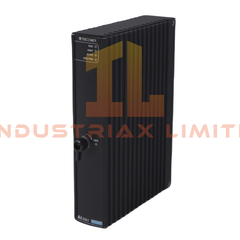
Yokogawa NFTR8S-10 Pressure Clamp Terminal Block Module Configured for field wiring termination between STARDOM I/O modules and field devices in...
Read more
Configured for field wiring termination between STARDOM I/O modules and field devices in Yokogawa STARDOM FCN/FCJ DCS platforms, the Yokogawa NFTR8S-10 S2 (NFTR8S-10 Pressure Clamp Terminal Block Module) provides direct physical/electrical execution of multi-channel signal routing between field termination points and modular I/O assemblies.
HardwareSpecifications
Parameter
Specification
ModelBrand
Yokogawa NFTR8S-10 S2
Origin
Japan
Weight
Approx. 0.1 kg
Dimensions
22 mm x 124 mm x 126 mm
OperatingTemp
0 degC to 55 degC (standard)
PowerConsumption
Passive module, no internal power consumption
Wiring Method
Spring-loaded pressure clamp terminals
Wire Range
0.5 mm2 to 2.5 mm2
Rated Voltage
Up to 250 VAC/VDC (system dependent)
Rated Current
Up to 24 A terminal rating
Yokogawa DCS Field Termination Interface Characteristics
The NFTR8S-10 is implemented as a passive field termination interface within Yokogawa STARDOM architectures, supporting structured signal routing to analog and RTD input modules such as NFAR series I/O cards. The pressure clamp mechanism provides constant-force contact pressure independent of mechanical torque retention, reducing variation in loop resistance under vibration exposure.
Channel wiring integrity is maintained for low-level instrumentation signals including 4-20 mA loops and resistance temperature detector circuits where junction stability and low contact impedance are required. The terminal structure supports consistent potential referencing for shielded cable grounding schemes and minimizes contact degradation under thermal cycling conditions.
FrequentlyAskedQuestions
Q: Does the NFTR8S-10 support electrical hot-swap during I/O module replacement A: The terminal block itself is passive and remains electrically static. Hot-swap capability depends on the connected STARDOM I/O module and system backplane design. Field wiring continuity is maintained via fixed clamp retention.
Q: Is channel-to-channel isolation provided within the NFTR8S-10 A: Isolation is not implemented inside the terminal block. Electrical isolation is determined by the connected I/O module. The NFTR8S-10 only provides physical termination and conductor separation.
Q: Can high-density analog loops such as 4-20 mA and RTD inputs be mixed on the same block A: Mixed signal routing is possible only according to system wiring design rules. The terminal block imposes no signal conditioning; separation and shielding must be defined at panel level.
FieldInstallationGuidelines
Field installation requires insertion of stripped conductors into the pressure clamp mechanism with verified conductor gauge compliance between 0.5 mm2 and 2.5 mm2. Ensure full seating of conductors to maintain stable contact force within the spring terminal assembly.
Shielded cables should be terminated according to single-point grounding rules at the panel side to avoid circulating ground currents across STARDOM I/O reference planes. Maintain segregation between analog, RTD, and discrete wiring bundles to reduce capacitive coupling effects.
No torque tools are required for termination; however, conductor pull-test verification is recommended after insertion to confirm mechanical retention integrity under vibration conditions.