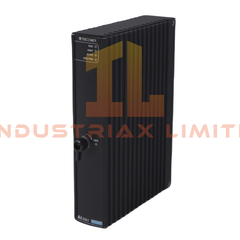
Yokogawa F3XC08-0C No-voltage Contact Input Module The Yokogawa F3XC08-0C, also cataloged as the F3XC08-0C No-voltage Contact Input Module, operates as...
Read more
The Yokogawa F3XC08-0C, also cataloged as the F3XC08-0C No-voltage Contact Input Module, operates as a dedicated hardware component for detecting and interfacing ON/OFF dry-contact signals within FA-M3 PLC platforms.
Hardware Specifications
Parameter
Specification
ModelBrand
Yokogawa F3XC08-0C
Origin
Japan
Weight
170 g
Dimensions
Compact module, standard FA-M3 form factor
OperatingTemp
0 degC to 55 degC
PowerConsumption
75 mA at 5 V DC
InputType
No-voltage contact (dry contact)
NumberOfInputs
8 channels
IsolationMethod
Transformer isolation per channel
InputRatings
5 V DC min., 20 mA max.
ONResistance
Max 200 Ω
OFFResistance
Min 100 kΩ
MaxSimultaneousInputs
100%
InputResponse
Sampling time selectable: 0 μs, 62.5 μs, 250 μs, 1 ms, 16 ms (response = sampling period + 1 ms max)
Connection
10-point terminal block, M3.5 screw
Common
Separate commons per input
Interrupt
Supported per input
Process Control Module Features
Channel-to-Channel Isolation: Each input has a dedicated common line, preventing electrical cross-talk and maintaining signal integrity in noisy environments.
DCS Integration: Compatible with 4-20 mA HART loop protocol systems for direct process monitoring.
Cold Junction Compensation (CJC): Maintains stable detection thresholds across ambient temperature variations.
Field Signal LED Indicators: Provides instantaneous visual verification of ON/OFF input states.
Frequently Asked Questions
Q: Can the F3XC08-0C handle external voltage on the input terminals? A: No, the inputs are designed for dry contacts only. Applying external voltage may damage the module.
Q: What is the input response time range? A: The input sampling time is selectable from 0 μs, 62.5 μs, 250 μs, 1 ms, to 16 ms. The effective response time is the sampling period plus 1 ms maximum.
Q: Is hot-swapping supported for this module? A: No, the module does not support hot-swap operation. Power must be removed from the rack prior to installation or removal.
Field Installation Guidelines
Ensure separate commons are properly wired for each channel to maintain isolation.
Route field signal wiring away from high-voltage AC or noisy switching lines to minimize interference.
Use recommended copper wire cross-section (0.33–0.82 mm²) and tighten M3.5 screws to 0.8 N·m.
Verify LED status indicators after wiring before applying power to the system.
Maintain transformer isolation distance and avoid bridging terminals between channels.