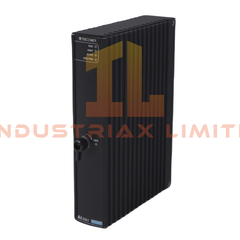
Yokogawa NFAP135-S50 Pulse Input Module Configured for pulse signal acquisition in STARDOM FCN/FCJ controller networks, the Yokogawa NFAP135-S50 (NFAP135-S50 Pulse...
Read more
Available on working days between 9:00 am to 6:00 pm
Email us: sales2@industriaxplc.com
Available 24/7 for inquiries and support
Description
Yokogawa NFAP135-S50 Pulse Input Module
Configured for pulse signal acquisition in STARDOM FCN/FCJ controller networks, the Yokogawa NFAP135-S50 (NFAP135-S50 Pulse Input Module) provides direct electrical execution of isolated pulse counting and event capture across distributed I/O architectures. The module processes contact, voltage, and current pulse inputs via fully isolated channels with high-speed digital sampling.
Suffix Breakdown & Model Matrix
NFAP135-S50 is a fixed configuration model identifier. No formal suffix segmentation or functional matrix decomposition is defined by the manufacturer for variant derivation.
Hardware Specifications
Parameter
Specification
Model
Yokogawa NFAP135-S50
Brand
Yokogawa
Origin
Japan
Module Type
8-Channel Pulse Input Module
Input Channels
8 channels, electrically isolated
Input Signal Types
Contact ON/OFF, voltage pulse, current pulse
Input Frequency Range
Up to 50 MHz per channel
Minimum Pulse Width
40 us
Isolation
Channel-to-channel and channel-to-system galvanic isolation
Contact Input Resistance
Open >= 100 kOhm / Close <= 200 ohm
Pull-up Resistance
68 kOhm (12 VDC / 24 VDC operation)
Shunt Resistance
OFF / 200 / 500 / 1000 ohm selectable
Data Refresh Cycle
2 ms
Transmitter Supply
12 VDC +/-10% or 24 VDC +/-10%
Power Consumption
5 VDC: 300 mA / 24 VDC: 400 mA
Operating Temperature
-20 degC to +60 degC
Weight
1.0 kg
Dimensions
482 mm (W) x 210 mm (H) x 220 mm (D)
Terminal Type
Pressure clamp terminal block / 40-pin MIL connector
Channel Isolation and Pulse Integrity Architecture
The NFAP135-S50 implements independent galvanic isolation barriers per channel, eliminating inter-channel ground coupling under high-density switching conditions. In Yokogawa process I/O architectures, this isolation layer is aligned with distributed signal conditioning practice similar to FOUNDATION Fieldbus segment separation principles, ensuring that pulse edge distortion, loop interference, and return-path modulation are contained at channel level. The input stage supports high-speed edge detection while maintaining deterministic sampling stability under electrically noisy field wiring conditions.
Frequently Asked Questions
Q: Can the NFAP135-S50 operate with hot-swapped field wiring under live backplane power? A: The module supports system-side hot insertion depending on STARDOM base unit configuration, but field terminals must not be re-wired under energized input conditions due to pulse integrity risk.
Q: Does channel-to-channel isolation eliminate cross-talk at high frequency operation? A: Yes. Each input channel is galvanically separated, reducing capacitive coupling and suppressing cross-channel pulse interference under high-density switching loads.
Q: What is the limiting factor for maximum pulse frequency per channel? A: The limiting factor is internal sampling resolution and input conditioning circuitry rather than field wiring, with stated support up to 50 MHz per channel.
Field Installation Guidelines
Shielded twisted pair wiring is required for all pulse input lines. Cable shields shall be terminated at a single-point ground on the control cabinet side to prevent ground loop formation. Input cables must be separated from high-voltage and VFD output lines by a minimum segregation distance defined by IEC industrial wiring practice. Terminal torque shall follow Yokogawa terminal block mechanical limits to ensure stable contact pressure on pressure clamp interfaces. Avoid parallel routing with power conductors exceeding 24 VDC switching levels over extended distances.