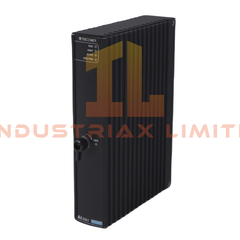
Configured for absolute vibration velocity measurement in machinery protection networks, the Bently Nevada 16699-10-02-01 (16699 Velocity Seismoprobe Transducer) provides direct electromechanical conversion of casing and bearing housing motion into proportional AC voltage signals without requiring external excitation power.
Mounting Option: Standard Stud Mount Configuration
-01
Connector Option: Standard MIL-C-5015 Style Connector
Hardware Specifications
Parameter
Specification
Model
16699-10-02-01
Brand
Bently Nevada
Origin
USA
Weight
Approx. 0.45 kg (Typical for seismic transducers)
Dimensions
Cylindrical Housing, Stud Mount Interface
Operating Temp
-29 deg C to +100 deg C
Power Consumption
Passive Self-Generating (No External Power Required)
Measurement Type
Absolute Vibration Velocity
Frequency Response
4.5 Hz to 1,000 Hz (270 to 60,000 CPM)
Resonant Frequency
> 4.5 kHz
Output Signal
Analog AC Voltage (Proportional to Velocity)
Transverse Sensitivity
<= 5% of Axial Sensitivity
Housing Material
Industrial-Grade Stainless Steel
Rotor Dynamics and Signal Integrity
The transducer's moving-coil design maintains linear output characteristics within the specified frequency band, supporting accurate rotor dynamics analysis when integrated with monitoring systems. The low transverse sensitivity specification minimizes cross-talk from orthogonal vibration components, ensuring that the measured signal represents true axial casing motion. Proper grounding at the termination point is required to prevent ground loops from corrupting the low-level AC signal in electrically noisy environments.
Frequently Asked Questions
Q: Is external power required for the 16699-10-02-01 to generate a signal?
A: No. This is a passive, self-generating moving-coil transducer. It produces an AC voltage directly proportional to vibration velocity without an external power supply.
Q: What is the standard mounting torque for the stud interface?
A: Use a standard 1/4-28 UNF stud mounting procedure. Engage threads fully and tighten to industrial equipment torque specifications to ensure mechanical rigidity and consistent frequency response.
Q: Can this transducer be used on slow-speed machinery below 4.5 Hz?
A: The operating range is specified as 4.5 Hz to 1,000 Hz. Below 4.5 Hz, the amplitude response rolls off, resulting in reduced accuracy for low-frequency vibration measurements.
Field Installation Guidelines
Mount the transducer directly to a rigid, flat surface on the machine casing or bearing housing using the provided stud. Ensure the mounting surface is free of paint, rust, and debris to maintain metal-to-metal contact. Route the cable away from high-voltage power lines and motor leads to minimize electromagnetic interference. Terminate the MIL-C-5015 connector securely, ensuring proper strain relief and environmental sealing to maintain integrity in harsh industrial conditions.