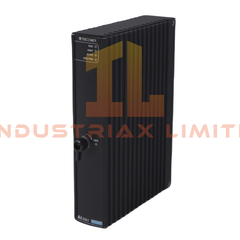
Yokogawa AMM22C Analog Input Multiplexer Unit The Yokogawa AMM22C (AMM22C) Analog Input Multiplexer Unit operates as a dedicated hardware component...
Read more
Available on working days between 9:00 am to 6:00 pm
Email us: sales2@industriaxplc.com
Available 24/7 for inquiries and support
Description
Yokogawa AMM22C Analog Input Multiplexer Unit
The Yokogawa AMM22C (AMM22C) Analog Input Multiplexer Unit operates as a dedicated hardware component for low-level millivolt and 4-20 mA signal acquisition within CENTUM VP / CS 3000 Field I/O architectures. Configured for channelized analog signal scanning in Yokogawa DCS Field Control Station environments, the Yokogawa AMM22C (AMM22C Analog Input Multiplexer Unit) provides direct electrical execution of 16-channel multiplexed input sampling with per-channel galvanic isolation.
Suffix Breakdown & Model Matrix
AMM22C is a fixed model designation. No structured suffix segmentation or option code decomposition is defined for this part number. Functional configuration is determined at system-level engineering within the Field I/O node and CENTUM VP / CS 3000 integration parameters.
Hardware Specifications
Parameter
Specification
ModelBrand
AMM22C / Yokogawa
Origin
Yokogawa Electric Corporation
Weight
3 kg (shipping condition, including packaging)
Dimensions
32.8 x 107.5 x 130 mm
OperatingTemp
0 degC to 60 degC
PowerConsumption
Not explicitly specified (system/backplane dependent)
Channels
16 analog input channels
Signal Types
Millivolt (mV), 4-20 mA DC
Input Resistance
250 ohm (current loop termination)
Resolution
12 to 16 bit (system configured)
Accuracy
+/-0.1% of full scale
Isolation
Channel-to-system galvanic isolation
Architecture
Multiplexed Field I/O scanning
Channel-to-Channel Isolation and Signal Integrity Behavior (Yokogawa DCS Architecture)
Within Yokogawa Electric Corporation Field I/O design, the AMM22C implements per-channel galvanic isolation between input termination stages and system backplane referencing. This isolation topology reduces ground potential coupling across mixed analog loops, particularly in 4-20 mA current measurement circuits where loop grounding differentials can introduce offset drift.
The multiplexed acquisition structure sequentially samples 16 inputs through an internal switching matrix. This architecture enforces deterministic scan behavior aligned with CENTUM VP / CS 3000 field control station timing cycles. Signal conditioning is performed prior to digitization to stabilize low-level millivolt inputs against line impedance variation and EMI coupling.
Frequently Asked Questions
Q1: Does AMM22C support hot-swap replacement under live backplane power? A1: Hot-swap capability is system-dependent and governed by the Field Control Station rack design. Electrical design of the module assumes backplane power sequencing compliance during insertion and removal.
Q2: How is channel isolation implemented across 16 inputs? A2: Each input channel is electrically isolated from system ground reference via galvanic isolation stages. This prevents inter-channel ground loop propagation during mixed signal acquisition.
Q3: Can AMM22C directly interface with HART overlay signals on 4-20 mA loops? A3: The module primarily performs analog multiplexed acquisition. HART signal handling depends on upstream system integration and is not inherently decoded at the multiplexer stage.
Field Installation Guidelines
The AMM22C shall be installed in a designated Yokogawa Field I/O node slot within CENTUM VP / CS 3000 compatible racks. Maintain segregation between low-level analog signal wiring and power conductors to reduce capacitive coupling noise.
Shield termination for 4-20 mA loops should be implemented at a single grounding point within the control cabinet to avoid ground loop formation. Signal cables must maintain minimum bend radius defined by instrumentation cable specification to prevent impedance discontinuities.
Backplane connector alignment must be verified prior to full insertion to prevent pin misalignment damage. Ensure all field wiring is torque-terminated according to terminal block mechanical specification.