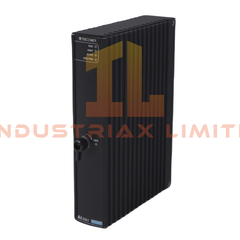
Yokogawa AIP601 Door Fan Unit Configured for forced cabinet airflow management in Vnet/IP based DCS enclosure architectures, the Yokogawa AIP601...
Read more
Available on working days between 9:00 am to 6:00 pm
Email us: sales2@industriaxplc.com
Available 24/7 for inquiries and support
Description
Yokogawa AIP601 Door Fan Unit
Configured for forced cabinet airflow management in Vnet/IP based DCS enclosure architectures, the Yokogawa AIP601 (AIP601 Door Fan Unit) provides direct electrical and mechanical execution of airflow regulation through integrated fan control and monitoring circuitry within Yokogawa system cabinets.
Suffix Breakdown & Model Matrix
AIP601 is defined as a fixed single-order module identifier. No additional suffix segmentation or functional option coding is specified in the provided manufacturer data.
Hardware Specifications
Parameter
Specification
ModelBrand
Yokogawa AIP601
Origin
Yokogawa
Rated Voltage
250 VAC, max 30 VDC
Vnet/IP Interface
Dual-redundant
FCU
1
Power Distribution Board
Built-in HKU, 1 unit
I/O Modules Capacity
Max 6 modules
Battery Backup (Main Memory)
Max 72 hours
Detectable Flow Rate
2 to 20 (unit not specified)
Process Control Cabinet Interface Characteristics
The Yokogawa AIP601 integrates into Vnet/IP based control architectures with dual-redundant communication paths, supporting deterministic data exchange between cabinet-level monitoring nodes and distributed control system backplanes. In Yokogawa DCS environments, cabinet auxiliary devices such as fan units are commonly aligned with 4-20 mA loop monitoring principles and channel isolation design logic to ensure signal integrity across mixed analog and digital subsystem boundaries. The internal FCU and power distribution architecture supports segmented electrical distribution with built-in HKU coordination for internal load balancing and supervisory control signaling.
Frequently Asked Questions
Q: Does the AIP601 support hot-swapping of the FCU module? A: No explicit hot-swap capability is specified for FCU replacement. Power isolation is required before mechanical replacement.
Q: What is the impact of dual-redundant Vnet/IP failure on fan operation? A: Fan operation is typically decoupled from network redundancy; however, monitoring and alarm signaling may degrade to single-path communication.
Q: What is the maximum supported I/O expansion load? A: Up to 6 I/O modules are supported; backplane current loading must remain within cabinet power distribution limits.
Field Installation Guidelines
The AIP601 shall be installed within Yokogawa-compatible cabinet door assemblies with verified mechanical alignment of airflow intake and exhaust channels. Ensure proper grounding of the power distribution board chassis to cabinet earth to maintain noise suppression integrity across Vnet/IP communication lines. Maintain separation between AC power routing (250 VAC) and low-level communication wiring to avoid induced coupling. All wiring termination points should follow standard industrial torque specifications for terminal blocks, and cable shielding must be terminated at a single earth reference point to avoid ground loop circulation.