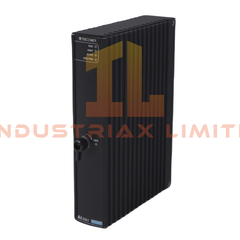
Yokogawa AAT145-S00 TC/RTD Input Module Configured for thermocouple, RTD, and potentiometer signal acquisition in CENTUM-series distributed control environments, the Yokogawa...
Read more
Available on working days between 9:00 am to 6:00 pm
Email us: sales2@industriaxplc.com
Available 24/7 for inquiries and support
Description
Yokogawa AAT145-S00 TC/RTD Input Module
Configured for thermocouple, RTD, and potentiometer signal acquisition in CENTUM-series distributed control environments, the Yokogawa AAT145-S00 (AAT145 TC/RTD Input Module) provides direct physical/electrical execution through 16 isolated analog input channels with per-channel signal selection capability.
Suffix Breakdown & Model Matrix
Model
Description
AAT145-S00
16-channel isolated TC/RTD/POT input module
AAT145
Base TC/RTD input module platform designation
Hardware Specifications
Parameter
Specification
Model
AAT145-S00
Brand
Yokogawa
Product Type
TC/RTD Input Module
Input Channels
16 isolated channels
Input Signal - mV
-100 to 150 mV, -20 to 80 mV
Input Signal - RTD
JIS C1604:1997, IEC751:1995 Pt100, 3-wire type
Input Signal - POT
Total resistance 100 Ohm to 10 kOhm
Span Resistance
50% or larger of total resistance
Channel Signal Selection
TC/mV individually selectable per channel; RTD/POT individually selectable per channel
Allowable Input Voltage
+/- 5 V
Withstanding Voltage
Input-to-system: 500 VAC for 1 minute; single card 1500 VAC for 1 minute
Channel Isolation Voltage
200 VAC between channels for 1 minute
Input Resistance
1 MOhm or larger, power ON/OFF
Accuracy - TC
+/- 40 uV
Accuracy - RTD
+/- 150 mOhm
Accuracy - POT
+/- 0.2% FS
Allowable Source + Wiring Resistance
100 Ohm or less
Reference Junction Compensation Accuracy
+/- 1 degC
Data Update Period
1 s
Burnout Detection
Common setting for all channels
Burnout Detection Time
60 s
Temperature Drift - TC
+/- 80 uV/10 degC
Temperature Drift - RTD
+/- 0.3 Ohm/10 degC
Temperature Drift - POT
+/- 0.4%/10 degC
Power Consumption
350 mA at 5 VDC maximum
External Connection
Dedicated KS1 cable
Weight
0.3 kg
Origin
Japan
Channel-to-Channel Isolation and Cold Junction Compensation
The module implements galvanic isolation between all 16 input channels to reduce common-mode interference propagation across mixed thermocouple and RTD measurement loops. Input-to-system insulation is rated at 500 VAC for standard operation and 1500 VAC for single-card testing conditions.
Integrated cold junction compensation is applied for thermocouple measurement processing with compensation accuracy maintained within +/- 1 degC. The module supports independent channel assignment between TC/mV and RTD/POT modes, allowing mixed sensor deployment on a single card without external conversion hardware.
Frequently Asked Questions
Q: Does the AAT145-S00 support mixed signal configurations on the same module? A: Yes. Each channel can be individually configured for TC/mV input or RTD/POT input operation.
Q: What burnout handling behavior is implemented on this module? A: Burnout detection is configured collectively for all channels. Detection time is specified as 60 s.
Q: Are all channels electrically isolated from each other? A: Yes. The module provides isolated input channels with 200 VAC channel-to-channel withstanding voltage rating for 1 minute.
Field Installation Guidelines
Use shielded instrumentation cable for all thermocouple and low-level millivolt signal wiring. Terminate cable shielding at a single grounding point on the control cabinet side to minimize ground loop current circulation.
Maintain physical separation between analog signal wiring and high-voltage power conductors inside cable trays and marshalling cabinets. Avoid parallel routing with inverter output cables or motor feeder circuits.
For Pt100 three-wire RTD circuits, maintain equal conductor length and conductor type across all three leads to minimize resistance imbalance effects during temperature calculation.
Verify KS1 dedicated cable connector engagement before energizing the module. Do not apply external voltage exceeding +/- 5 V to any analog input channel.