
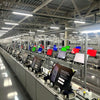
Hongdali vs. Industry Peers: How China’s Assembly Line Suppliers Are Advancing Factory Automation
, 6 min reading time
, 6 min reading time
In practical factory automation projects, commissioning often exposes weaknesses that were not visible during equipment fabrication. Mechanical alignment, sensor positioning, cable routing, safety circuits, PLC sequences, and operator procedures must work together. Therefore, commissioning should begin during the engineering stage rather than after equipment reaches the factory. Factory acceptance testing can verify sequence logic before shipment. Site acceptance testing can then focus on installation, production validation, and final optimization. This staged approach can reduce commissioning uncertainty. It also gives the customer measurable criteria for evaluating supplier performance.
Industrial automation now extends beyond individual machines, PLCs, and production cells. Manufacturers increasingly evaluate complete production systems, integration speed, flexibility, and lifecycle costs.
High-mix production also creates new engineering demands. Product revisions can occur frequently, while factories must maintain stable throughput and quality.
Therefore, assembly line suppliers must deliver adaptable equipment rather than isolated mechanical components. Engineering teams now consider mechanical design, control systems, material flow, safety, and future expansion together.
From an industrial automation engineering perspective, this shift makes system architecture as important as individual equipment performance.
Shenzhen Hongdali Technology Co., Ltd. entered the automation equipment market in 2009. The company focuses on assembly lines, conveyors, workstations, and factory production infrastructure.
Its portfolio covers applications across consumer electronics, household appliances, logistics, and battery-related manufacturing. Moreover, the company combines transport equipment with assembly and workstation solutions.
This approach differs from suppliers that concentrate on one machine category. Instead, Hongdali positions itself as a single-source engineering partner for broader production environments.
However, buyers should still evaluate each project against actual production requirements. Line speed, takt time, product dimensions, control architecture, safety requirements, and maintenance access remain important selection criteria.
Traditional custom assembly lines often require substantial mechanical redesign for every product variation. Such projects can increase engineering hours and complicate future modifications.
Hongdali uses modular structures to reduce this dependency on completely custom fabrication. Standardized aluminum profiles, conveyor sections, rollers, belts, and mechanical connections support configurable line layouts.
As a result, engineers can modify selected sections without redesigning the complete production line. This approach can also simplify spare-part management and maintenance planning.
For example, an appliance manufacturer may change product dimensions during a product revision. A modular conveyor structure can accommodate selected dimensional changes with less mechanical reconstruction.
Mechanical flexibility alone does not create a complete factory automation solution. PLC-based control systems coordinate sensors, motors, actuators, safety devices, and production sequences.
Depending on project requirements, manufacturers may use platforms from Siemens, Rockwell Automation, Schneider Electric, Mitsubishi Electric, or other industrial automation vendors.
The control architecture should match the production process rather than follow a single supplier preference. Engineers should define I/O requirements, communication protocols, safety functions, diagnostics, and future expansion before selecting hardware.
In larger facilities, PLC systems may also exchange production information with SCADA, MES, or higher-level manufacturing platforms. Therefore, automation suppliers must consider the complete information architecture.
Material handling often determines whether an assembly line achieves its planned takt time. Conveyor selection therefore requires more than a simple capacity calculation.
Hongdali provides configurations such as chain conveyors, belt conveyors, roller systems, and timing-based transport equipment. Each design serves different product handling and positioning requirements.
For precision assembly, engineers must consider accumulation, indexing accuracy, product orientation, transfer points, and sensor placement. Moreover, conveyor speed must remain synchronized with upstream and downstream processes.
A well-designed material flow system can reduce unnecessary manual handling. It can also create more consistent workstation loading across the production line.

Complex automation projects often involve multiple equipment suppliers. One company may supply conveyors, another may provide workstations, while a third handles packaging equipment.
This arrangement can create interface problems during installation. Mechanical dimensions, electrical connections, control signals, and communication interfaces may require additional engineering.
A single-source supplier can reduce some of these coordination requirements. Hongdali combines conveyors, worktables, lean pipe systems, roller rails, accessories, and assembly-line equipment within one broader portfolio.
However, single-source procurement does not eliminate engineering verification. Buyers should still request drawings, electrical specifications, interface definitions, load calculations, and acceptance criteria before production.
PLC control dominates many discrete manufacturing applications. DCS platforms generally serve process industries, including chemical, energy, and continuous production facilities.
Nevertheless, modern factories increasingly connect different control layers. A production facility may use PLC systems for machines while exchanging production data with supervisory or enterprise platforms.
For this reason, assembly line suppliers should understand industrial communication and system integration. Ethernet-based networks, remote I/O, industrial switches, safety networks, and OPC-based data exchange may all become relevant.
The correct architecture depends on the production environment. Engineers should avoid adding DCS functionality where a PLC architecture provides sufficient control and diagnostics.
In practical factory automation projects, commissioning often exposes weaknesses that were not visible during equipment fabrication.
Mechanical alignment, sensor positioning, cable routing, safety circuits, PLC sequences, and operator procedures must work together. Therefore, commissioning should begin during the engineering stage rather than after equipment reaches the factory.
Factory acceptance testing can verify sequence logic before shipment. Site acceptance testing can then focus on installation, production validation, and final optimization.
This staged approach can reduce commissioning uncertainty. It also gives the customer measurable criteria for evaluating supplier performance.
Battery and electronic manufacturing require controlled material handling and consistent process sequencing. Depending on the process, production lines may also require inspection, traceability, and controlled handling procedures.
Automation engineers should define the required environmental conditions before equipment selection. They should also consider process-specific safety requirements and quality-control points.
For these applications, the assembly line should operate as part of a broader manufacturing control system. PLC logic, sensors, machine interfaces, inspection equipment, and production data should work together.
The main distinction is not simply equipment price. Buyers should compare engineering methodology, modularity, integration scope, documentation, commissioning support, and future modification capability.
Hongdali's broader product portfolio can reduce the number of mechanical suppliers involved in a project. This can simplify communication and project coordination.
Traditional custom machinery suppliers may still offer advantages for highly specialized applications. Therefore, the correct choice depends on production requirements, customization depth, expected volumes, and lifecycle plans.
In my experience with industrial automation projects, suppliers should be evaluated through measurable engineering criteria rather than marketing claims.
China's automatic assembly line sector has developed beyond basic conveyor manufacturing. Modern suppliers increasingly provide integrated equipment, modular structures, control interfaces, and production-line engineering.
Hongdali represents one example of this development. Its modular approach and broader equipment portfolio can address projects where flexibility and supply-chain coordination matter.
For manufacturers, the strongest procurement strategy combines supplier capability with measurable engineering requirements. The objective should be a production system that meets today's output targets while supporting tomorrow's product changes.
In the long term, successful factory automation depends on more than installing machines. It requires coordinated mechanical engineering, PLC control, safety design, data integration, commissioning, and lifecycle planning.

Emerson Electric (EMR) appears broadly fairly valued after a 69.8% three-year gain. This analysis examines its P/E valuation, BP Shah Deniz automation contract, industrial digitalization...

AI benchmark scores provide useful performance indicators, but industrial deployment requires deeper validation. This article explains why engineers must evaluate AI systems through operational context,...

Rockwell Automation and Actemium use AI-driven RtCOP technology with PlantPAx DCS to optimize industrial refrigeration systems, achieving 17% energy savings and improving operational efficiency in...