
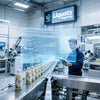
Empowering Plant-Based Manufacturing: How Liquats Vegetals Leverages Digital Transformation for Efficiency and Sustainability
, 2 min reading time
, 2 min reading time
Sustainability is no longer optional; it’s a core operational priority. Liquats Vegetals uses FactoryTalk Energy Manager to gain real-time visibility into energy and utility consumption. By identifying inefficiencies and monitoring usage patterns, the plant can implement measures to reduce environmental impact. I find that embedding energy intelligence into production workflows is one of the most tangible ways automation drives both cost savings and sustainability.
Rockwell Automation supports Liquats Vegetals’ digital transformation, enhancing production flexibility, energy efficiency, and sustainability through advanced automation, real-time data visibility, and integrated industrial solutions.
Rockwell Automation is partnering with Liquats Vegetals, a leading Spanish producer of plant-based beverages, to accelerate their digital transformation. By deploying advanced industrial automation and data management technologies, the collaboration is designed to enhance operational visibility, process consistency, and energy transparency across the company’s production facilities.
The plant-based food and beverage sector is evolving rapidly, requiring manufacturers to handle a growing variety of formulations, frequent production changes, and heightened sustainability demands. Liquats Vegetals is proactively addressing these challenges by implementing digital solutions that enable real-time insights and more informed decision-making. This approach ensures both operational resilience and product quality across its Catalonia-based sites.
Central to the initiative is Rockwell Automation’s PlantPAx distributed control system. This technology enhances process flexibility, efficiently manages multiple formulations, and supports frequent product changeovers—all while maintaining consistent quality. From my perspective as an automation engineer, integrating such a system is a game-changer for companies looking to scale operations without sacrificing precision or traceability.
Sustainability is no longer optional; it’s a core operational priority. Liquats Vegetals uses FactoryTalk Energy Manager to gain real-time visibility into energy and utility consumption. By identifying inefficiencies and monitoring usage patterns, the plant can implement measures to reduce environmental impact. I find that embedding energy intelligence into production workflows is one of the most tangible ways automation drives both cost savings and sustainability.
The adoption of DataMosaix consolidates production, energy, and sustainability data into a single platform. This unified approach improves traceability, supports continuous improvement, and enables proactive operational optimization. In my experience, connecting disparate data streams into a centralized system transforms not only decision-making speed but also accuracy, creating measurable value for operations.
Jose Paredes of Rockwell Automation notes that advanced data visibility is critical for modern manufacturing. Tasio Corachán Masriera from Liquats Vegetals emphasizes that centralized, reliable operational data enables better decisions in increasingly complex production environments. Combining real-time production intelligence with energy management empowers manufacturers to optimize resource utilization while upholding high-quality standards.
By integrating advanced automation, energy management, and centralized data solutions, Liquats Vegetals is positioning itself as a leader in sustainable, flexible, and efficient plant-based manufacturing. From my viewpoint, this project exemplifies how digital transformation, when thoughtfully applied, can deliver both operational excellence and environmental stewardship—a model every industrial facility can learn from.


Emerson Electric (EMR) appears broadly fairly valued after a 69.8% three-year gain. This analysis examines its P/E valuation, BP Shah Deniz automation contract, industrial digitalization...

AI benchmark scores provide useful performance indicators, but industrial deployment requires deeper validation. This article explains why engineers must evaluate AI systems through operational context,...

Rockwell Automation and Actemium use AI-driven RtCOP technology with PlantPAx DCS to optimize industrial refrigeration systems, achieving 17% energy savings and improving operational efficiency in...