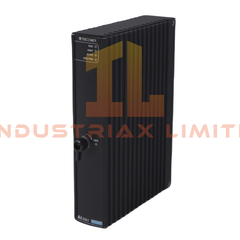
Configured for triaxial vibration acquisition and wireless telemetry in ISA100.11a sensor networks, the Bently Nevada 143M6282-01 (143M6282-01 wireless vibration monitor) provides direct physical/electrical execution for distributed machine condition data acquisition across System 1 integration layers.
Suffix Breakdown & Model Matrix
No officially published suffix segmentation or functional sub-code breakdown is defined for the 143M6282-01 ordering designation within the provided engineering dataset. The identifier is treated as a single fixed-order hardware configuration.
Hardware Specifications
Parameter
Specification
Model
143M6282-01
Brand
Bently Nevada
Origin
USA
Operating Temp
-40 deg C to +85 deg C
Power Consumption
Battery powered (replaceable Li-SOCl2 D-cell, consumption not quantified in provided data)
Product Type
Wireless Vibration Monitor / Sensor
Measurement Axes
Triaxial (X, Y, Z simultaneous acquisition)
Wireless Protocol
ISA100.11a
Frequency Range
Up to 10 kHz
Wireless Range
Up to 150 m line of sight
Battery Life
Up to 5 years (application dependent)
Enclosure Rating
IP67
Software Interface
Bently Nevada System 1
Cross-Axis Vibration Sampling and Rotor Dynamics Context
The measurement architecture supports simultaneous triaxial acceleration capture, enabling reconstruction of rotor dynamic behavior under multi-plane excitation. In rotating machinery analysis, cross-axis correlation is used to evaluate vibration phase coupling between radial and axial components. This allows detection of synchronous and asynchronous vibration modes, including imbalance-related harmonics and structural looseness signatures.
Signal integrity in multi-sensor wireless deployments is maintained through time-synchronized sampling windows and spatial channel separation, reducing cross-talk between adjacent acquisition nodes in dense machine train installations. The data stream is suitable for spectral decomposition, envelope analysis, and broadband RMS trending within condition monitoring systems.
Frequently Asked Questions (FAQ)
Q: Does the 143M6282-01 support simultaneous triaxial sampling or time-multiplexed acquisition? A: The device architecture is defined for simultaneous X, Y, and Z axis acquisition, ensuring phase-aligned vibration vector measurement across all channels.
Q: What is the wireless communication constraint in dense ISA100.11a networks? A: Network throughput is governed by ISA100.11a scheduling, where sampling interval and retransmission slots determine effective update latency under multi-node deployments.
Q: Can the sensor data be integrated directly into System 1 without gateway translation? A: Integration requires ISA100.11a network infrastructure; data is forwarded through compatible wireless gateways before ingestion into System 1.
Field Installation Guidelines
Mounting shall be performed using threaded stud or adhesive interface depending on machine surface geometry. The mounting surface must maintain rigid mechanical coupling to avoid attenuation of high-frequency vibration components above 5 kHz.
Orientation should align sensor axes with machine radial and axial reference directions. Cable shielding is not applicable at the sensor node; however, grounding integrity of nearby machinery frames must be maintained to reduce electromagnetic interference coupling into the wireless transmission path.
Installation spacing in multi-sensor deployments should avoid direct mechanical resonance coupling between adjacent mounting points. Minimum separation is determined by structural stiffness and machine casing modal response characteristics.
Battery installation must follow polarity alignment defined by terminal markings. Environmental sealing integrity shall be verified after mounting to maintain IP67 ingress protection rating.